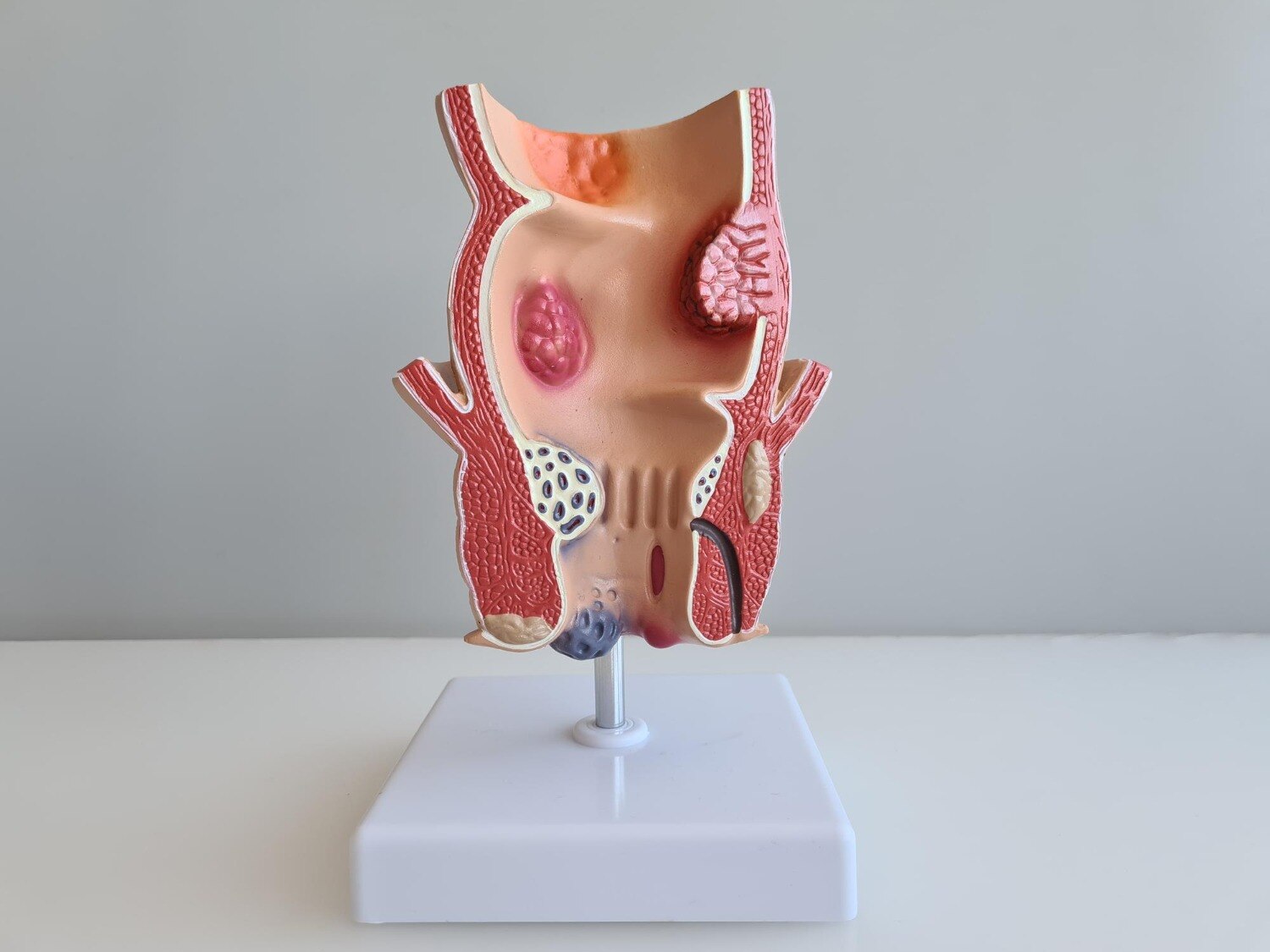
A mass from the anus and a lump in the groin can both appear during straining, but they come from different anatomical areas and require different evaluations. By comparing the location, appearance, associated symptoms and warning signs, you can describe what you are seeing accurately and seek the right assessment without forcing or repeatedly examining the tissue.
Key takeaways
- A lump through the anus points to rectal prolapse, not an inguinal hernia.
- A groin lump that enlarges with coughing points to an inguinal hernia.
- Do not force a painful or trapped lump back into place.
- Seek urgent care for severe pain, vomiting, skin colour changes or inability to pass stool.
Where the lump appears tells you which condition is more likely
Location is the strongest initial clue: rectal prolapse is rectal tissue sliding through the anus, while an inguinal hernia is tissue pushing through the inguinal canal into the groin, scrotum or labia. A mass coming through the anus is not an inguinal hernia, although both conditions can coexist.
| Where you see the lump | More likely condition | What it usually looks like |
|---|---|---|
| Groin crease, scrotum or labia | Inguinal hernia | A bulge that becomes more visible when standing, coughing or straining |
| Anus | Rectal prolapse | A red or pink mass emerging during a bowel movement |
Inspect the groin crease, scrotum or labia for an inguinal hernia, then inspect the anus for prolapse. A hernia lump may shrink or disappear when you lie down, while prolapsed rectal tissue appears at the anal opening.
The location is not the only clue. Rectal prolapse can cause mucus leakage, bleeding, constipation, a sensation of incomplete evacuation, faecal incontinence or the need to push tissue back inside. Early prolapse can retract on its own; later prolapse may require manual reduction.
Prolapsed hemorrhoids can also resemble rectal prolapse. Separate bluish or red-purple cushions suggest hemorrhoids, whereas full-thickness prolapse forms a circumferential rectal wall with concentric folds. A clinician should assess any uncertain mass.
The associated symptoms separate prolapse from a groin hernia
Mucus leakage, incomplete evacuation, constipation, faecal incontinence and bleeding point more strongly toward rectal prolapse. You may feel tissue coming out during a bowel movement and need to push it back inside. Early prolapse can retract on its own; later prolapse may require manual reduction.
| Condition | Symptoms that support it | What you may notice |
|---|---|---|
| Rectal prolapse | Mucus leakage, incomplete emptying, constipation, faecal incontinence or bleeding | Red or pink tissue emerges through the anus, often during a bowel movement |
| Inguinal hernia | Groin heaviness, burning, pressure, aching or dragging discomfort | A bulge worsens with standing, coughing, lifting or straining and improves when lying down or after it reduces |
The pattern of inguinal hernia symptoms is different because the discomfort centres on the groin, scrotum or labia, not the anus. A reducible bulge often becomes less prominent when you lie down; a painful bulge that stays firm needs urgent assessment.
Prolapsed internal hemorrhoids can look similar. Hemorrhoids usually form separate bluish or red-purple cushions, whereas full-thickness rectal prolapse appears as a circumferential rectal wall with concentric folds.
Do not assume every anal mass is piles. An anal mass that repeatedly protrudes, leaks mucus, bleeds or requires pushing back warrants an examination, especially if it remains outside or becomes painful.
Use a safe self-check, then recognise the emergency signs
At home, safely observe the mass without trying to diagnose or manipulate it. Record what you see and seek medical assessment if the finding persists, returns, or worries you.
- Note the location: is it at the anus, in the groin crease, or in the scrotum or labia?
- Note the trigger: does it appear while standing, coughing or straining, or does red or pink tissue emerge during a bowel movement?
- Lie down and observe whether the lump reduces on its own. Do not force a painful groin lump back.
- Record pain, bleeding, mucus or other discharge. Do not repeatedly probe the anus, and do not assume every protruding mass is piles.
Seek urgent medical care for:
- A firm lump or one that cannot be reduced
- Severe or increasing pain
- Vomiting or abdominal swelling
- Inability to pass stool or gas
- Fever
- Dark or black tissue
- Heavy bleeding
- Anal tissue that remains outside and becomes painful, discoloured or ulcerated
These signs can indicate trapped tissue. A groin hernia can become incarcerated or strangulated, cutting off the tissue’s blood supply. Exposed rectal tissue can also swell and become compromised, so do not keep pushing it back when reduction is painful or unsuccessful.
A standing examination usually identifies the source of the mass
History and physical examination often distinguish rectal prolapse from an inguinal hernia without imaging. The clinician asks when the mass appears, where it is located, whether it reduces and whether pain or bleeding occurs. For a suspected hernia, they examine the groin and may ask you to stand, cough or strain.
For suspected rectal prolapse, they inspect the anus and may ask you to bear down.
During the examination, the clinician checks:
- The groin, scrotum or labia for a bulge that appears with coughing or straining and reduces when you lie down.
- The anus for protruding rectal tissue, hemorrhoids or another anal mass.
- The groin lymph nodes and surrounding tissues for enlarged nodes or a lump unrelated to either condition.
Ultrasound helps when a small or occult groin hernia is not clear during examination. It can show movement of tissue through the inguinal canal during straining. A normal scan does not erase an obvious, reducible groin bulge that the clinician can see and feel.
CT or MRI may be considered when the examination suggests another abdominal or pelvic diagnosis, a complicated hernia or a deeper mass. These scans are not automatic for a straightforward case, and they cannot replace an examination of both the anus and groin.
Treatment depends on confirming whether the problem is prolapse or hernia
Once the examination confirms the diagnosis, treatment follows different paths. Adult full-thickness rectal prolapse usually needs definitive surgery; constipation treatment alone may reduce straining but usually does not restore the prolapsed rectal wall.
| Option | What it involves | When it is considered |
|---|---|---|
| Abdominal rectopexy | Securing the rectum through an abdominal approach | Selected according to age, comorbidities, prolapse features, constipation and continence |
| Perineal operation | Repair through the perineum, without an abdominal approach | Useful when patient factors or prolapse characteristics favour this route |
| Open hernia repair | Repair through a groin incision | An option for a confirmed symptomatic inguinal hernia |
| Laparoscopic hernia repair | Repair through ports, usually with mesh | Helpful for bilateral disease or recurrence after an anterior repair; requires general anaesthesia, an appropriately trained team and acceptance of port-related risks |
Symptomatic inguinal hernias are generally repaired rather than treated with medicines. Laparoscopy can mean less early wound pain, but it is not automatically the better choice for every patient.
For rectal prolapse treatment in Nagpur, choose a colorectal, general or gastrointestinal surgeon who examines both the anus and groin. For a hernia consultation in Nagpur, report the exact location, triggers such as standing or coughing, and whether the lump reduces when you lie down.
Dr Hemant Chhajed Surgeon can assess both sites and confirm the diagnosis before surgery is discussed.
Related services
Expertise ₹500 An inguinal hernia occurs when tissue, such as part of the intestine, protrudes through a weak spot in the abdominal muscles. View service → |
Expertise ₹500 Hernias are a common medical condition that occurs when an organ or fatty tissue pushes through a weak spot in the surrounding muscles or connective... View service → |
Frequently asked questions
Can rectal prolapse be mistaken for an inguinal hernia?
The conditions can be confused when symptoms are described vaguely, but their locations differ. Rectal prolapse comes through the anus; an inguinal hernia forms in the groin and can extend into the scrotum or labia.
What symptoms help distinguish rectal prolapse from an inguinal hernia?
Rectal prolapse can cause tissue protruding from the anus, mucus, bleeding, constipation or incomplete evacuation. Inguinal hernia symptoms include a groin bulge, aching or pressure that worsens with standing, coughing or lifting.
How can you safely check whether a lump is prolapse or a hernia?
Observe where the lump appears while standing and coughing, without forceful pressing. Do not push back a painful, firm or discoloured mass, and arrange a clinical examination.
When is a lump an emergency?
Seek urgent care for severe or increasing pain, vomiting, abdominal swelling, inability to pass stool or gas, a firm lump that will not go back, or dark red, purple or black tissue.
How are rectal prolapse and inguinal hernia treated?
Treatment follows the diagnosis. Rectal prolapse may require bowel-management measures or surgery, while an inguinal hernia is assessed for watchful waiting or surgical repair based on symptoms and risk.
Keywords