
An umbilical hernia appears as a bulge around the navel when tissue pushes through a weak area in the abdominal wall. In adults, it may begin as a small, painless swelling but gradually become uncomfortable or increase in size.
Unlike many umbilical hernias in infants, adult umbilical hernias usually do not close on their own. Dr Hemant Chhajed helps patients understand whether observation is reasonable or whether umbilical hernia surgery offers a more suitable long-term solution.
When Can an Umbilical Hernia Be Observed?
A small hernia that is painless, easily reducible and not changing may sometimes be monitored. Observation does not repair the weakness; it simply means surgery is not immediately necessary based on the current findings.
Monitoring generally involves watching for:
- Increase in the size of the bulge
- New pain or tenderness
- Difficulty pushing the swelling back
- Skin redness or colour change
- Nausea or vomiting
- Abdominal distension
- Changes in bowel movements
Support belts may temporarily reduce discomfort in selected situations, but they do not close the defect or prevent every complication.
When Does Surgery Become More Appropriate?
Surgery may be considered when the hernia is painful, enlarging or affecting exercise and routine activity. Repair may also be advised when the hernia contains bowel, cannot be reduced or carries a higher risk of becoming trapped.
Adults with obesity, pregnancy history, chronic cough, constipation or repeated heavy lifting may experience increasing pressure on the weakened navel area. The timing of surgery should account for these factors as well as the patient’s general health.
Umbilical Hernia Repair in Nagpur
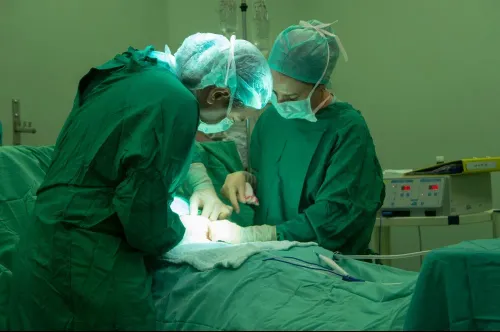
During umbilical hernia surgery in Nagpur, Maharashtra, the protruding tissue is returned to the abdomen and the opening is repaired. Depending on the size of the defect, the repair may use sutures alone or mesh reinforcement.
Suture repair may be considered for certain small defects. Mesh repair spreads tension across a broader area and may be recommended when the defect is larger or the risk of recurrence is higher.
The procedure may be performed through an open incision near the navel or through a laparoscopic approach. Factors influencing the choice include:
- Diameter of the hernia opening
- Body weight
- Previous abdominal surgery
- Presence of multiple defects
- Hernia recurrence
- Condition of the surrounding skin
- Overall medical fitness
Questions to Ask Before Choosing Repair
A useful discussion with the surgeon should cover the expected method, anaesthesia, possible use of mesh, recovery time and lifting restrictions. Patients should also ask what symptoms would require urgent evaluation before the planned surgery.
Health conditions such as diabetes, high blood pressure or lung disease may need to be stabilised beforehand. Smoking cessation and weight management can also improve healing and reduce strain on the repair.
Life After Umbilical Hernia Surgery
Most patients are encouraged to walk soon after the procedure while avoiding strenuous exercise and heavy lifting for the recommended period. Returning too quickly to physically demanding work can place pressure on the healing abdominal wall.
Persistent fever, wound discharge, increasing swelling, vomiting or severe pain should be reported promptly.
Choosing between observation and surgery depends on more than the visible size of the bulge. Symptoms, reducibility, lifestyle and risk of future complications all matter.
If a swelling around the navel is growing or becoming painful, consult Dr Hemant Chhajed for an appropriate evaluation and treatment plan.
Keywords