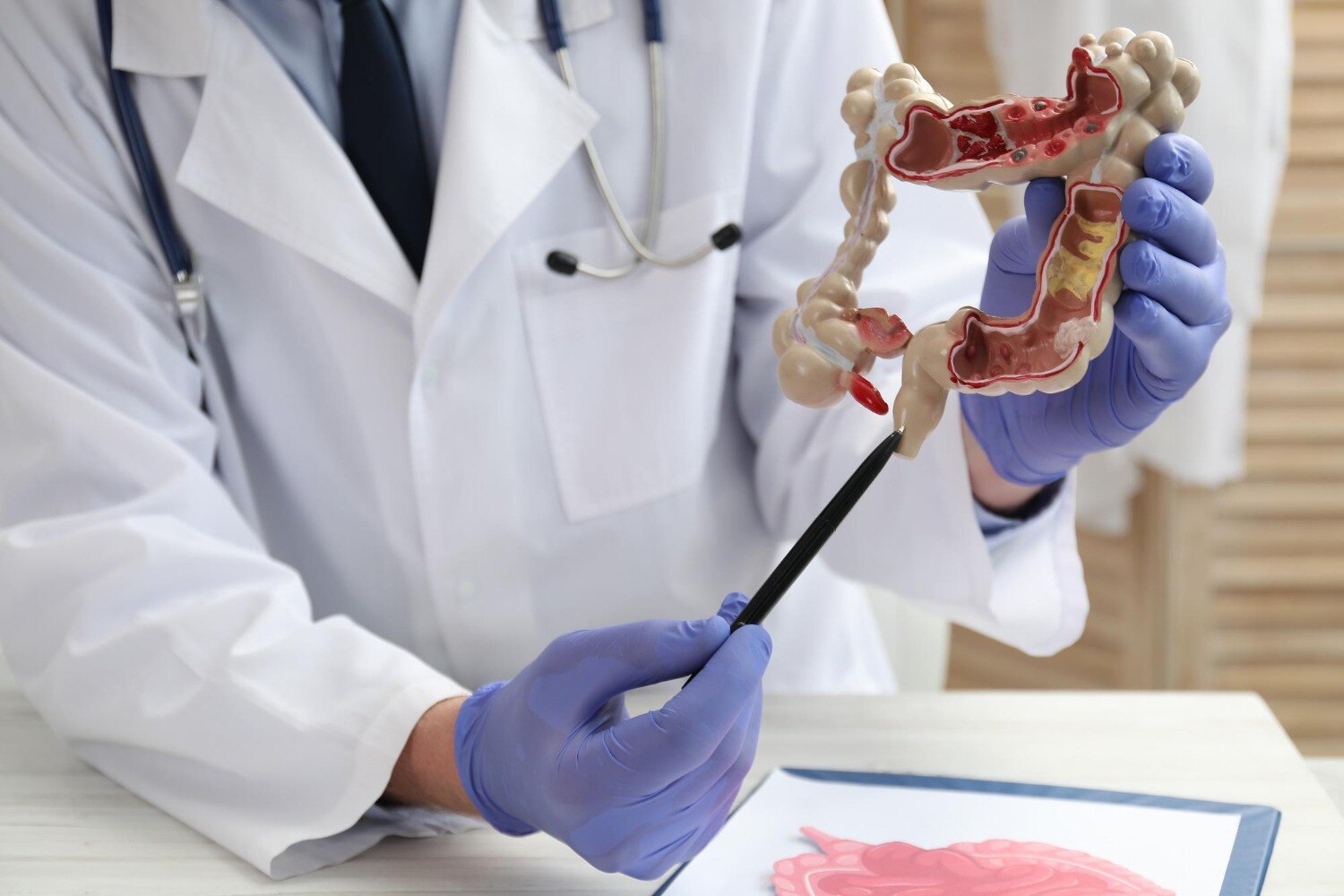
A groin lump that changes with standing or coughing points toward a structural problem in the abdominal wall, while bleeding, anaemia or a persistent bowel-habit change points toward investigation of the colon. Matching the symptom pattern to the right first assessment helps you avoid an irrelevant test and identify symptoms that need urgent care.
Key takeaways
- A bulge that appears with coughing or standing points to hernia assessment first.
- Colonoscopy investigates bowel symptoms, not a visible groin lump.
- Seek urgent care for severe pain, vomiting, or a bulge that will not go back.
- A surgeon can coordinate hernia and lower GI evaluation when symptoms overlap.
Which symptoms point to a hernia evaluation rather than colonoscopy?
A lump that appears when you stand, cough or strain points first to an inguinal hernia evaluation, especially when lifting triggers groin pain or the bulge disappears after you lie down.
Choosing between lower GI endoscopy and inguinal hernia assessment for symptoms in Nagpur starts with this distinction: is the problem in the abdominal wall, or inside the bowel?
| Symptom pattern | More consistent with | Why |
|---|---|---|
| Groin lump that changes with standing, coughing or straining | Inguinal hernia | Pressure exposes a weakness in the groin wall |
| Pain after lifting or exertion | Inguinal hernia | Movement loads the abdominal wall |
| Bulge that reduces when lying down | Inguinal hernia | The protrusion returns inward with reduced pressure |
| Rectal bleeding or black stool | Bowel evaluation | These can indicate bleeding in the gastrointestinal tract |
| Persistent bowel-habit change, constipation, chronic diarrhoea or mucus | Bowel evaluation | Ongoing intestinal symptoms need clinical assessment |
| Iron-deficiency anaemia, weight loss or lower abdominal pain | Bowel evaluation | These findings can require colorectal investigation |
Colonoscopy for bowel symptoms examines the rectum and colon, and sometimes the terminal ileum when the instrument reaches it. It does not inspect the groin muscles or abdominal wall and generally does not diagnose an inguinal hernia. A colonoscopy is therefore not routinely justified by isolated groin pain or a changing groin lump.
Seek urgent medical assessment for a painful swelling that will not reduce, particularly with vomiting, abdominal distension, inability to pass stool or gas, fever or marked tenderness. A hernia and bowel condition can occur together, so rectal bleeding, black stool, anaemia or weight loss still need evaluation even when a hernia is present.
What happens during an inguinal hernia consultation?
The consultation begins with a history of the groin symptom, not a colonoscopy. The clinician asks about:
- Which side hurts or swells
- How long it has been present
- Whether lifting, coughing or straining triggers pain
- Whether the bulge is enlarging
- Whether it limits walking, work or exercise
Both groins are examined while you are standing and then lying down. Coughing or performing a Valsalva manoeuvre can reveal a cough impulse. The clinician records the swelling’s size, checks whether it reduces with gentle pressure, and assesses its relation to the pubic tubercle.
A normal examination does not end the evaluation. Similar groin pain can come from:
- A femoral hernia
- Hip disease
- An adductor or abdominal-wall injury
- Nerve entrapment
- Urinary or genital conditions
- Enlarged lymph nodes
Dynamic groin ultrasound is useful when the examination is uncertain or an occult hernia is suspected. Ask whether the scan will include standing and coughing or straining; a scan performed only while lying down can miss a position-dependent bulge. MRI can be considered when ultrasound is nondiagnostic and suspicion remains.
A painful swelling that cannot be reduced needs urgent assessment, especially with vomiting, abdominal distension, inability to pass stool or gas, fever or marked tenderness. For inguinal hernia groin pain in Nagpur, these findings require urgent care rather than routine scheduling.
An inguinal hernia consultation in Nagpur should also investigate non-hernia causes when the examination is normal.
When is lower GI endoscopy appropriate for bowel symptoms?
A colonoscopy examines the rectum and entire colon, while a flexible sigmoidoscopy examines the rectum and lower colon. Neither test inspects the groin muscles or abdominal wall, so an isolated groin bulge or nonspecific groin pain does not routinely justify endoscopy.
| Test | What it examines | When it applies |
|---|---|---|
| Colonoscopy | Entire colon; terminal ileum when reached | Bleeding, anaemia, persistent bowel changes, abnormal imaging or surveillance |
| Flexible sigmoidoscopy | Rectum and lower colon | Selected symptoms or findings limited to the lower bowel |
| Hernia assessment | Groin, abdominal wall and bulge behaviour | Lump or pain triggered by standing, coughing, straining or lifting |
A referral for colonoscopy for bowel symptoms is appropriate when you have:
- Rectal bleeding or black stool
- Iron-deficiency anaemia
- Persistent unexplained change in bowel habit or diarrhoea
- Suspected inflammatory bowel disease
- Abnormal colorectal imaging
- Surveillance after polyps or colorectal cancer
Average-risk colorectal screening is commonly offered from ages 45 to 75. A normal, adequately prepared colonoscopy is commonly repeated after 10 years; stool-based tests use shorter intervals. Family history, risk factors, previous findings and test quality change the interval.
Preparation usually involves a low-residue diet followed by clear liquids and split-dose bowel preparation. Discuss medicines beforehand. Risks include sedation reactions, bleeding and perforation; bleeding and other complications become more likely after large-polyp removal. The same clinical indications guide lower gi endoscopy in nagpur.
Can a hernia and a bowel condition exist at the same time?
A confirmed inguinal hernia does not explain rectal bleeding, black stool, persistent anaemia, unexplained weight loss, or a sustained change in bowel habit. These symptoms need separate clinician-led evaluation based on severity, age, family history, risk factors, and screening history.
The reverse is also true: colonoscopy can find a bowel abnormality, but it does not examine the groin wall or prove that a groin lump is caused by bowel. Two diagnoses can coexist.
- For inguinal hernia groin pain in Nagpur, arrange a hernia assessment when a bulge changes with standing, coughing, or lifting, or when pain follows exertion. A reducible, minimally symptomatic hernia may be monitored in selected men; increasing pain, enlargement, activity limitation, or difficulty reducing it shifts discussion toward elective repair.
- Discuss lower GI endoscopy in Nagpur for bleeding, black stool, iron-deficiency anaemia, unexplained weight loss, persistent bowel-habit change, or age- and risk-based colorectal screening.
- Seek urgent care for a painful swelling that cannot be pushed back, especially with vomiting, abdominal distension, inability to pass stool or gas, fever, or marked tenderness.
- If the hernia examination is normal, continue the investigation. Musculoskeletal, hip, nerve, urinary, genital, lymph-node, and bowel conditions can all cause groin symptoms.
A colonoscopy is not a substitute for examining a groin lump, and finding a hernia is not a reason to dismiss bowel warning signs.
How should you choose care for groin symptoms in Nagpur?
A changing groin bulge or pain brought on by lifting calls for an inguinal hernia consultation in Nagpur, not an automatic colonoscopy. Bring the painful side, photographs of a bulge that disappears, triggers such as coughing or lifting, whether it reduces when lying down, bowel changes, bleeding, weight loss, medication details and prior abdominal operations.
| Option | What it examines | When to choose it |
|---|---|---|
| Hernia assessment | Groin, abdominal wall and possible musculoskeletal causes | Bulge, exertional pain or pain with coughing |
| Lower GI endoscopy | Rectum and colon; colonoscopy may reach the terminal ileum | Bleeding, iron-deficiency anaemia, persistent bowel change, unexplained diarrhoea or screening |
| Urgent assessment | Possible trapped hernia, obstruction or strangulation | Severe pain, irreducibility, vomiting, distension, fever or inability to pass stool or gas |
A general and laparoscopic abdominal surgeon, such as Dr Hemant Chhajed Surgeon, can examine both groins standing and lying down, then decide whether dynamic ultrasound with coughing or straining, MRI or another investigation is needed. A normal examination redirects evaluation toward hip, muscle, nerve, urinary or bowel causes.
Lower GI endoscopy in Nagpur should follow clinical indications, not replace a groin examination.
- Groin bulge or exertional pain: start with hernia assessment.
- Bleeding, anaemia, persistent bowel change or screening need: discuss colorectal evaluation.
- Severe pain, irreducibility, vomiting or obstruction: seek urgent medical care.
Related services
Expertise ₹500 An inguinal hernia occurs when tissue, such as part of the intestine, protrudes through a weak spot in the abdominal muscles. View service → |
Expertise ₹500 Hernias are a common medical condition that occurs when an organ or fatty tissue pushes through a weak spot in the surrounding muscles or connective... View service → |
Frequently asked questions
Which symptoms point to a hernia evaluation rather than colonoscopy?
A groin lump that appears when you stand, cough, lift, or strain points to an inguinal hernia evaluation. Pain that improves when you lie down also supports this route. Colonoscopy does not assess the abdominal wall defect causing a hernia.
What happens during an inguinal hernia consultation?
The surgeon asks when the lump and pain occur, examines your groin while standing and lying down, and may ask you to cough or strain. If the diagnosis is unclear, an ultrasound or other imaging test can help.
When is lower GI endoscopy appropriate for bowel symptoms?
Lower GI endoscopy, including colonoscopy, investigates symptoms such as rectal bleeding, persistent changes in bowel habits, unexplained iron-deficiency anaemia, or ongoing abdominal symptoms. A clinician decides whether it is appropriate after reviewing your history and examination.
Can a hernia and a bowel condition exist at the same time?
Yes. A groin bulge can result from an inguinal hernia while bleeding, altered bowel habits, or persistent abdominal symptoms have a separate bowel cause. Your clinician may arrange both surgical assessment and lower GI evaluation.
How should you choose care for groin symptoms in Nagpur?
Choose a service that can examine the groin, assess bowel symptoms, arrange imaging or lower GI endoscopy when indicated, and explain whether surgery is needed. For inguinal hernia groin pain in Nagpur, a consultation with Dr Hemant Chhajed Surgeon can provide a focused surgical assessment.
Keywords